
Bali – a bucket-list destination for so many, and until recently, for us too – is famously known as the ‘Island of the Gods’. It owes this nickname to its unique culture and the profound influence of Balinese Hinduism, which you’ll notice at every turn. In fact, you have to be careful where you step! The Balinese people leave offerings for their gods almost everywhere, from doorsteps to the middle of the pavement.
This stunning island is full of hidden gems, one of the most famous being Ubud – the cultural and spiritual heart of Bali. However, there’s a corner of Ubud where the gods aren’t the only ones in charge. Here, the monkeys rule the roost – long-tailed macaques, to be precise. While you’ll spot them in many places across Bali, seeing them in Ubud is a unique, guaranteed experience. All you have to do is head to the Sacred Monkey Forest.
In today’s guide, we’ll take you step-by-step through the Balinese jungle inhabited by these cheeky macaques. You’ll find out how to plan a safe and successful visit, what to do (and what not to do) to stay on the monkeys’ good side, the best time to visit, and how to snap that iconic ‘monkey selfie’.
Ubud Monkey Forest: At a Glance
📍 Location: Ubud, Bali
🗺️ Getting there: Walking from Ubud centre / by scooter or car / hiring a private driver / taxi or Grab / as part of an organised tour
💰 Entrance fee: 130 000 IDR (approx. € 6.30)
⏰ Opening hours: 9:00–18:00
🚗 Parking: Large, paid parking area for scooters and cars right by the entrance
📆 Best time to visit: Dry season (May to October); early morning or late afternoon to avoid the midday heat and crowds

The Monkey Sanctuary
The Sacred Monkey Forest Sanctuary – or simply the “Monkey Forest” as it’s commonly known – is a truly extraordinary place and a must-see on any Bali itinerary. Thanks to its 14th-century temple complex, the forest is considered a holy site by the Balinese, while also serving as home to over 1,200 long-tailed macaques. And you guessed it – the locals consider the monkeys themselves to be sacred too!
Interestingly, in Balinese culture, monkeys represent a bit of a duality, symbolising both protection and evil spirits. This mythology is a key element of traditional Balinese art. While the forest is filled with stone carvings dedicated to these animals, they appear in more than just sculpture; you’ll also see them featured in famous traditional dances like the Kecak and the Ramayana.
🧐 Travel Insight: While exploring the Monkey Forest, you might come across a local procession heading to one of the temples for a ceremony. You’ll see women in traditional dresses carrying baskets of offerings on their heads, accompanied by the hypnotic, rhythmic sounds of drums. These aren’t tourist performances – it’s a glimpse into authentic, living Balinese culture.
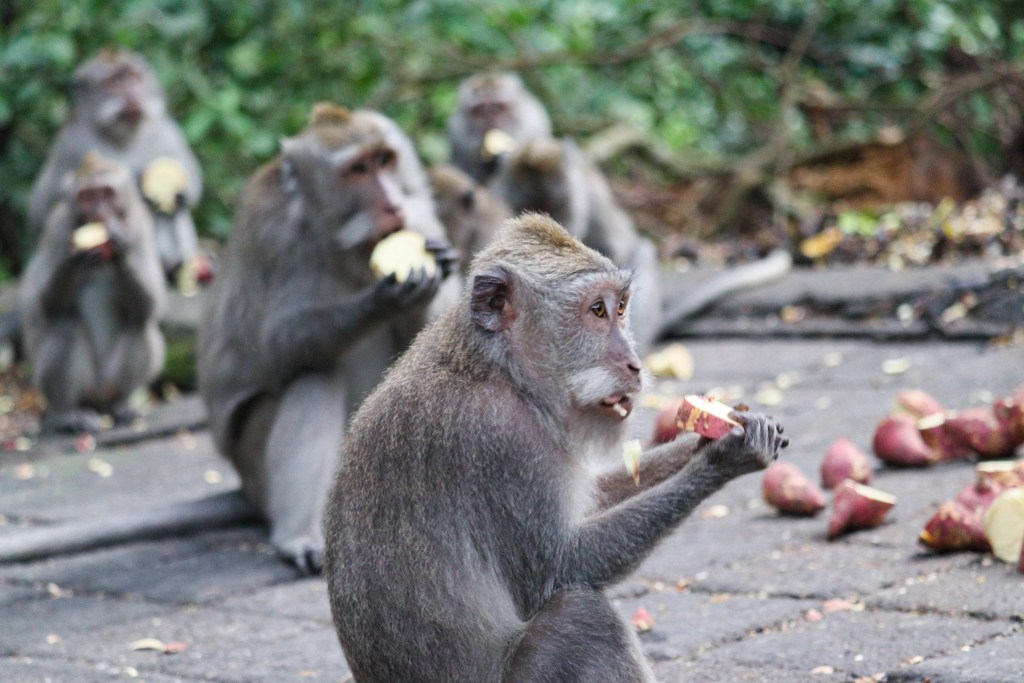
The macaques living in the sanctuary are semi-wild. They are fed and looked after, but they aren’t kept there against their will. With very few exceptions, you won’t see any monkeys in cages; only those who wouldn’t survive in the wild due to disabilities are kept in enclosures for their own safety. In fact, these monkeys frequently wander beyond the forest walls, leaping across nearby rooftops and performing acrobatics on the overhead cables that criss-cross the streets.
The Monkey Forest isn’t just a tourist attraction; it’s also a hub for researchers from around the world who come to study the macaques’ social interactions and their relationship with the environment. Simply walking through the forest and witnessing their complex behaviour is a fascinating experience in itself. And to top it off, they are incredibly photogenic! 😁


Meet the Locals: Balinese Monkeys
As we’ve already mentioned, you don’t have to look very far to find monkeys in Bali. The island is home to two native monkey species. The most common is the long-tailed macaque (Macaca fascicularis) – the very same species that calls the Ubud Monkey Forest home. It is also known as the crab-eating macaque or Javan macaque.
Much less frequently, you might spot Javan langurs (Trachypithecus auratus), also known as ebony leaf monkeys. These slender, dark-furred monkeys are much harder to spot than macaques and can be found, among other places, in West Bali National Park (Taman Nasional Bali Barat).
The macaques in the Ubud sanctuary are divided into ten distinct groups, each consisting of between 100 and 200 members of all ages.
With such a high density of monkeys in one forest, territorial disputes are, unfortunately, quite common. This is especially true when one group has to venture into another’s “patch” – for example, to reach the river during the dry season. Because of these scuffles, you might notice some monkeys with bite marks or battle scars during your visit. 😥
Ubud Monkey Forest: Practical Information
Now that you’re well-versed in the forest and its furry residents, it’s time to get down to the nitty-gritty of planning your visit!
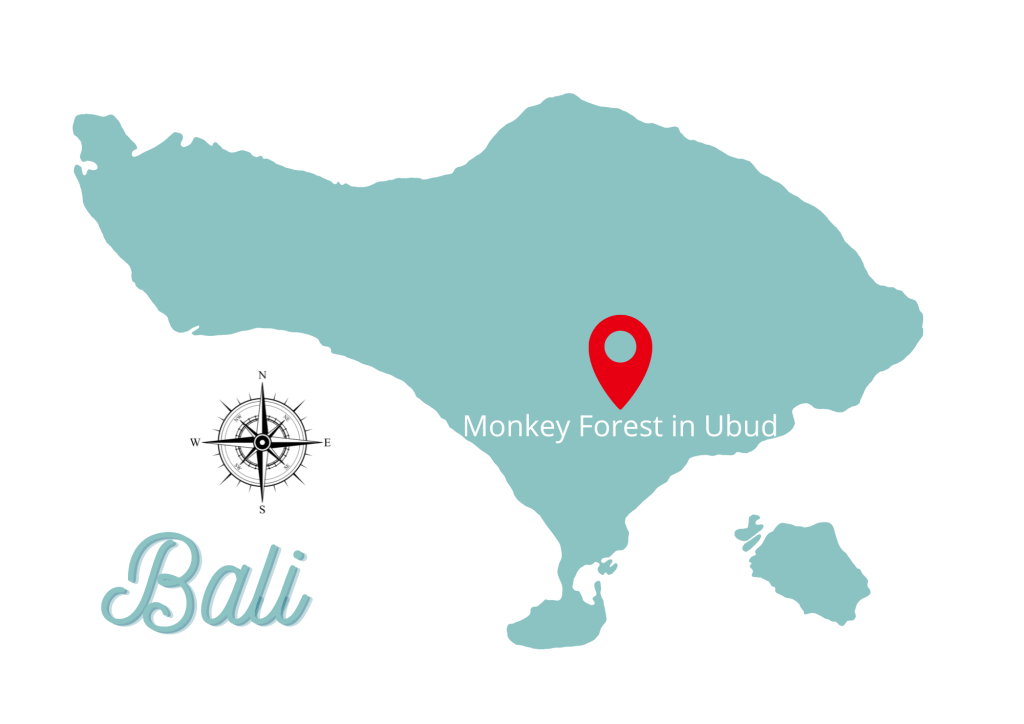
Where Is the Ubud Monkey Forest Located?
The Monkey Forest is nestled in the jungle on the fringes of Ubud town. It’s very easy to reach by scooter or car, and if you’re staying in the heart of Ubud, you can quite comfortably get there on foot. Another great option is using Grab— Southeast Asia’s answer to Uber.
The Best Time to Visit Ubud Monkey Forest
Ubud Monkey Forest is open daily from 09:00 to 18:00.
The ticket office closes at 17:00, but we wouldn’t recommend starting your visit that late for several reasons:
- It’s huge: The sanctuary covers over 12 hectares, and an hour simply isn’t enough to see it all. Honestly, we could have spent the whole day there! 😂
- The “monkey tax”: You’ll inevitably find yourself stopping every few metres to watch the monkeys. They are the stars of the show, after all, and that definitely adds time to your walk.
- The temples: While the macaques are the main draw, the temple complex is stunning and well worth your time. Although entry is reserved for religious purposes only, they are still incredible to look at from the outside. 😊
- The “Monkey Selfie”: If you’re dreaming of getting that iconic photo, keep in mind that the photo booth will already be closed.
- Early closing: Even though the forest officially closes at 18:00, the staff start ushering visitors toward the exit about 10–15 minutes early, and the deeper parts of the forest are “cleared” even sooner.
To beat the crowds, your best bet is to arrive as soon as it opens or visit in the afternoon.
💡 Pro Tip: Don’t forget your mosquito repellent! 🦟


Visiting the Monkey Forest in the Wet Season
In Bali, the rainy season runs roughly from November to April. During this time, heavy downpours can make the paths muddy and slippery — something to keep in mind when choosing your footwear! You should also expect sudden showers, especially in the afternoon.
That said, the weather usually bothers the tourists more than the locals; the macaques are out and about all year round.
The rainy season does have its perks, though — he main one being far fewer tourists.
Keep in mind that rainfall usually peaks in January (December and February are also very wet), but if you visit at the beginning or end of the season, you might still get some great weather.
A few tips for the wet season:
- Head there early: You’ll have a much better chance of avoiding the afternoon rain.
- Pack a raincoat or poncho: It’s always better to be prepared for a sudden downpour.
- Choose the right shoes: Wear shoes with good grip in case the paths are slippery.

How Much Is the Entrance Fee for the Monkey Forest?
The standard ticket price for an adult at the Ubud Monkey Forest is 130,000 IDR (approx. €6.30).
For children aged 3–12, the ticket costs 100,000 IDR (approx. €4.80), while little ones under the age of 3 can enter for free.
Unusually for Bali, the ticket office accepts both cash and card payments. You’ll also find ticket machines on-site, and if you want to skip the queues entirely, you can buy your tickets online in advance through the official Monkey Forest Ubud website.
How to Get to the Ubud Monkey Forest
- On foot: If you’re staying in central Ubud, the forest is just a short stroll away—it shouldn’t take you more than 15 minutes to get there.
- By scooter or car: Having your own set of wheels is the most convenient way to visit. That is, of course, if you’re brave enough to face the Indonesian traffic and the inevitable jams (always allow extra time for your journey!).
- By taxi or Grab: For short distances, a local taxi is fine, but for longer trips, we recommend using Grab (the Southeast Asian version of Uber). It usually offers much lower fares, and the app allows you to set your destination and pay online, which is a huge plus.
- As part of a day tour: Many organised tours of Ubud include the Monkey Forest as one of their main stops.
- Hiring a private driver: This is a very popular option in Bali — you can hire a driver for the whole day who will take you to the forest and other nearby attractions.

Where to Park at the Ubud Monkey Forest
Finding a parking spot in Bali can often be a bit of a nightmare. Fortunately, the Monkey Forest is an exception to the rule. Right by the entrance to the sanctuary, there is a large, paid car park with plenty of space for both scooters and cars.
The parking fees are very modest:
- Scooters: 2,000 IDR (approx. €0.10) for the first hour, and 1,000 IDR for every hour thereafter.
- Cars: 5,000 IDR (approx. €0.25) for the first hour, and 2,000 IDR for every hour thereafter.
📢 Important: If you’re planning to drive yourself around Bali, remember that an International Driving Licence is legally required. While we’ve personally never been pulled over by the police, we’ve heard plenty of stories about tourists being stopped for spot checks. 👮🏻
💡 Tip: When parking your scooter near the Monkey Forest, make sure you don’t leave any loose items that might catch a monkey’s eye. Around here, even a simple bottle of water can vanish in the blink of an eye! 🐒
The Temples of the Ubud Monkey Forest
The Monkey Forest is situated within a sacred temple complex that remains an active place of worship for Balinese Hindus to this day. Don’t be surprised if you spot a procession winding its way through the forest paths with baskets of offerings – it’s a perfectly normal sight here.

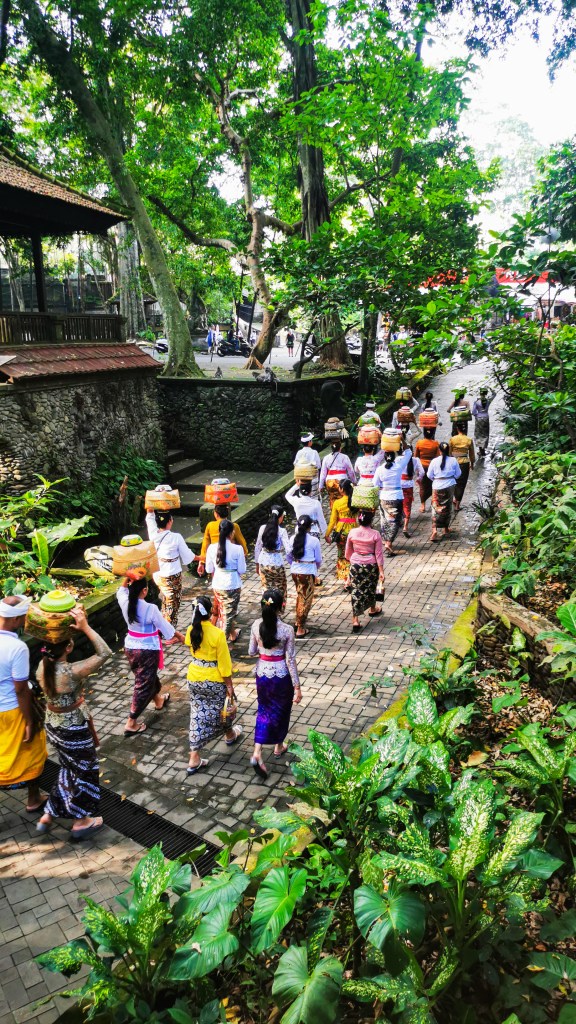
There are three main temples within the complex:
- Pura Dalem Agung Padangtegal – The main temple, dedicated to the god Shiva.
- Pura Beji Padang Tegal – A temple dedicated to the goddess Ganga (the personification of the Ganges River). It features a holy spring used for purification before religious ceremonies.
- Pura Prajapati Padangtegal – Known as the cremation temple. It’s located next to a cemetery where the deceased await the mass cremation ritual, which takes place every five years.
As a tourist, you’ll only be able to view these temples from the outside, as entry is strictly reserved for those attending for religious purposes.
However, Balinese temples are open-air structures, so you can see a great deal of the beautiful architecture without actually stepping inside. It’s well worth taking a moment to admire them while you stroll among the lively macaques.

How long should you spend at the Ubud Monkey Forest?
The amount of time you need is quite personal. It really depends on whether you want to cover every single trail or if (like us) you love to stop, observe the animals, and head home with a massive collection of photos.
While a quick walk-through technically takes about an hour, we recommend setting aside at least 2–3 hours to really soak it all in.
📢 Good to know: The best way to avoid a bite is to simply not play with the monkeys. They might look friendly, but they are still wild animals. A friend of ours from Brazil was actually bitten while playing with one of them. 🙈 If you do get bitten, make sure to see a doctor immediately. There is a clinic right next to the forest that provides rabies vaccinations (post-exposure prophylaxis).

Monkey Etiquette: The Rules of the Jungle
The Monkey Forest has its own set of “house rules” designed to keep both the animals and the visitors safe and happy.
While the macaques aren’t naturally aggressive, they will defend themselves if they feel threatened or spooked. Although Bali’s macaques are currently considered rabies-free, any bite still requires a trip to the local clinic for a check-up.
The furry residents here don’t have quite the same “thieving” reputation as the monkeys at Uluwatu Temple, but you still need to be careful with your belongings… you never know what might catch their eye! 🙊
Here’s how to stay on their good side:
- Don’t panic: This is rule number one. Whatever happens, stay calm. If you start screaming, you might scare the monkey into biting. If a monkey jumps on you, don’t try to push it off—simply bend over or “duck down”, and they will usually hop off on their own.
- Avoid eye contact and don’t smile: This one is tricky for humans! In “monkey language,” showing your teeth (even in a friendly smile) is a sign of aggression. Similarly, staring them in the eye is seen as a challenge. If a macaque bares its teeth at you, take it as a sign to calmly move away.
- No plastic or paper bags: Monkey logic is simple: a rustling bag = food. There’s always a cheeky macaque ready to try and snatch a bag from your hands, so it’s best not to bring any plastic or paper bags into the forest at all.
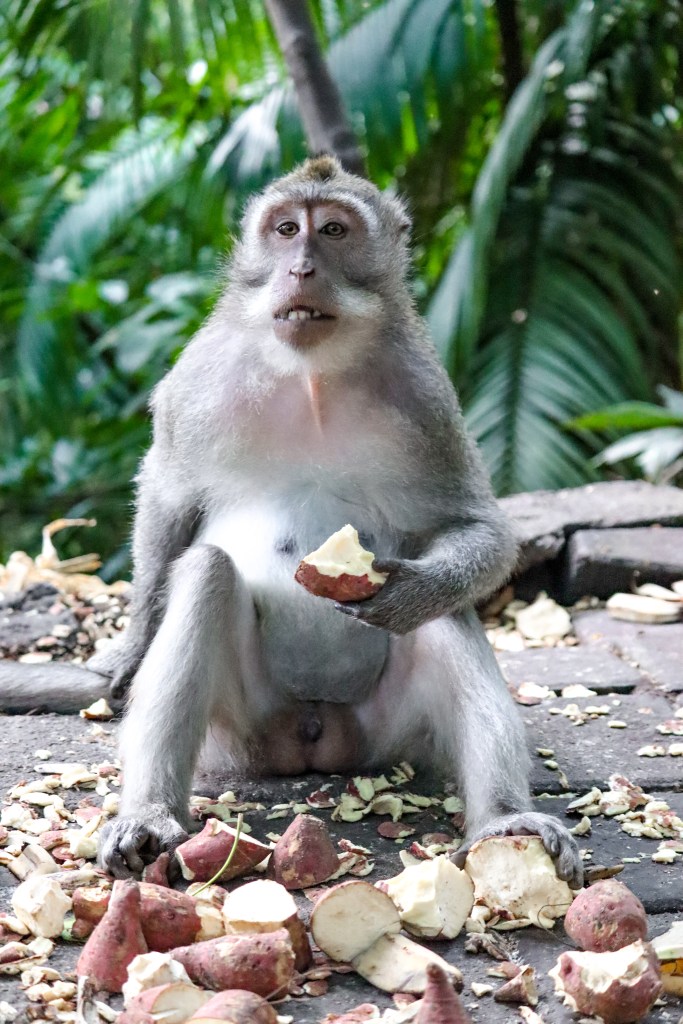
- Don’t bring food: The macaques here are fed nine times a day! Their diet consists mainly of sweet potatoes, but they also get bananas, papaya leaves, corn, and coconuts. However, they are always on the lookout for extra snacks. Their sensitive noses will find food anywhere, so keep all snacks out of the forest and keep your drinks tucked away in a zipped bag. This helps keep the monkeys healthy and prevents any “food-related” aggression. 🤗
- No “people food”: Following on from that, human snacks like sweets, nuts, or biscuits are definitely not on the menu. Sadly, despite the ban, we still saw some tourists trying to lure monkeys with treats. Please don’t be that person!
- Watch your belongings: It only takes a second for one of the 1,260 monkeys to swipe your gear. 🙈 Sunglasses, earrings, and any kind of jewellery are fair game. One monkey took a real interest in a flower-shaped hair clip I was wearing — luckily, he couldn’t get it off! Be especially careful with phones and wallets; these little pickpockets can be up a tree with your valuables before you even realise what’s happened.
- Respect the temples: The forest is a sacred site. While the rules can be a bit relaxed in the forest itself, a temple dress code (covering shoulders and knees) is technically required for the complex.
- Look, but don’t touch: This is the golden rule. Never try to touch or grab the monkeys. Their reactions are unpredictable, especially if they get a fright. If they touch you, that’s fine, but stay cautious. It’s tempting to play with the babies, but remember: their mums are very protective and much less “cute” when they think their baby is in danger! 😅
So, should you be worried about visiting? Absolutely not! If you follow these simple rules, you’ll avoid any trouble and have a fantastic time watching these fascinating creatures in their natural habitat. 😊

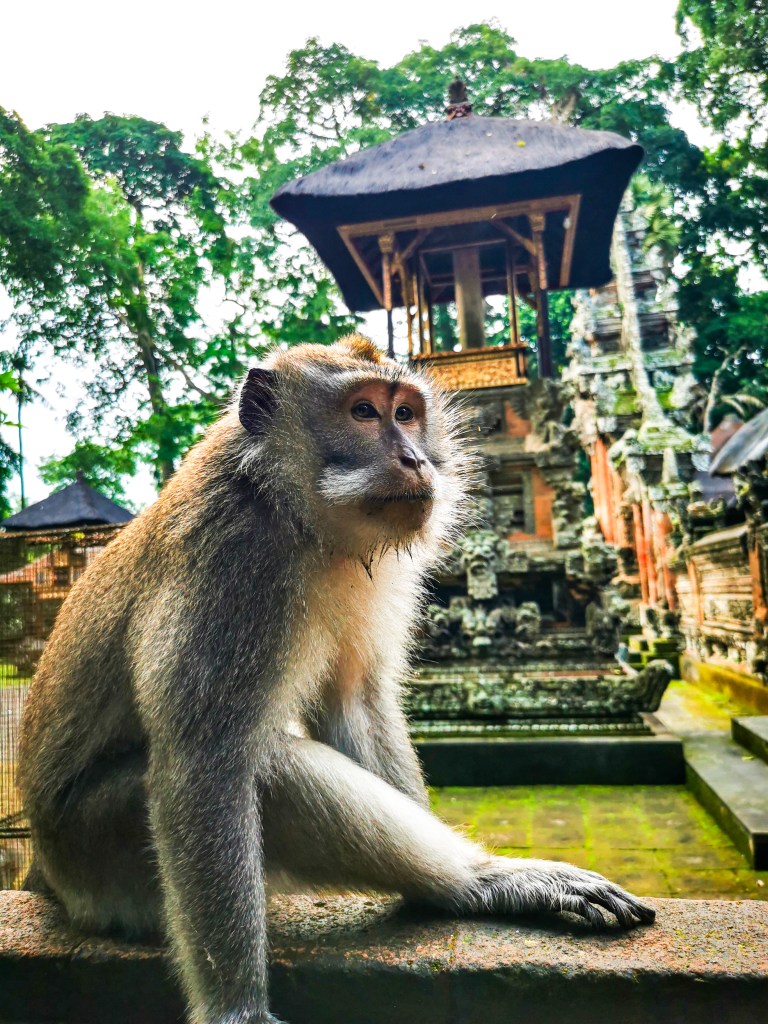
How to Snag the Iconic Monkey Selfie
If you’ve been browsing Bali travel tips online, you’ve almost certainly seen those viral selfies of tourists with macaques. It’s easily one of the most unique and fun souvenirs you can bring home from Ubud. If you’re wondering how to get one for yourself, here’s the lowdown.
First things first: remember the golden rule. You aren’t allowed to approach or touch the monkeys yourself. While they might choose to interact with you, you should never force it. Because of this, trying to take a “DIY” monkey selfie on your own is strictly prohibited.
Instead, the forest offers an official service called the “Monkey Moment.” You’ll find several small booths selling vouchers for this experience — the first one is located about a 5–7 minute walk into the temple complex.
The cost? It’s 50,000 IDR (approx. €2.40). This is generally the price per person, but if you’re a couple and only want one joint photo, you usually only need to pay once. It’s always worth double-checking the latest policy with the staff on the day, though.
Once you’ve got your voucher, head over to the square by the fountain. You’ll likely find a bit of a queue there.
Don’t worry about the technical side of things; a forest ranger will take the photo for you using your own phone. They hold a few treats just above the camera lens to tempt the monkey to reach for them—and that’s exactly how they get that famous “holding the phone” selfie effect!
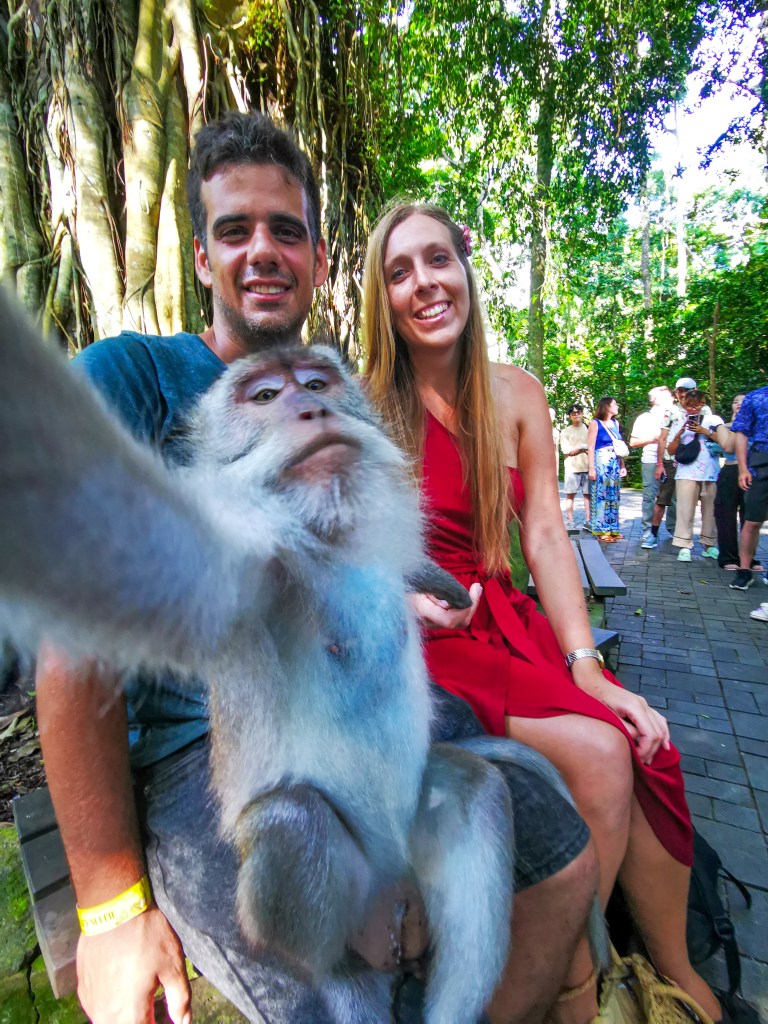
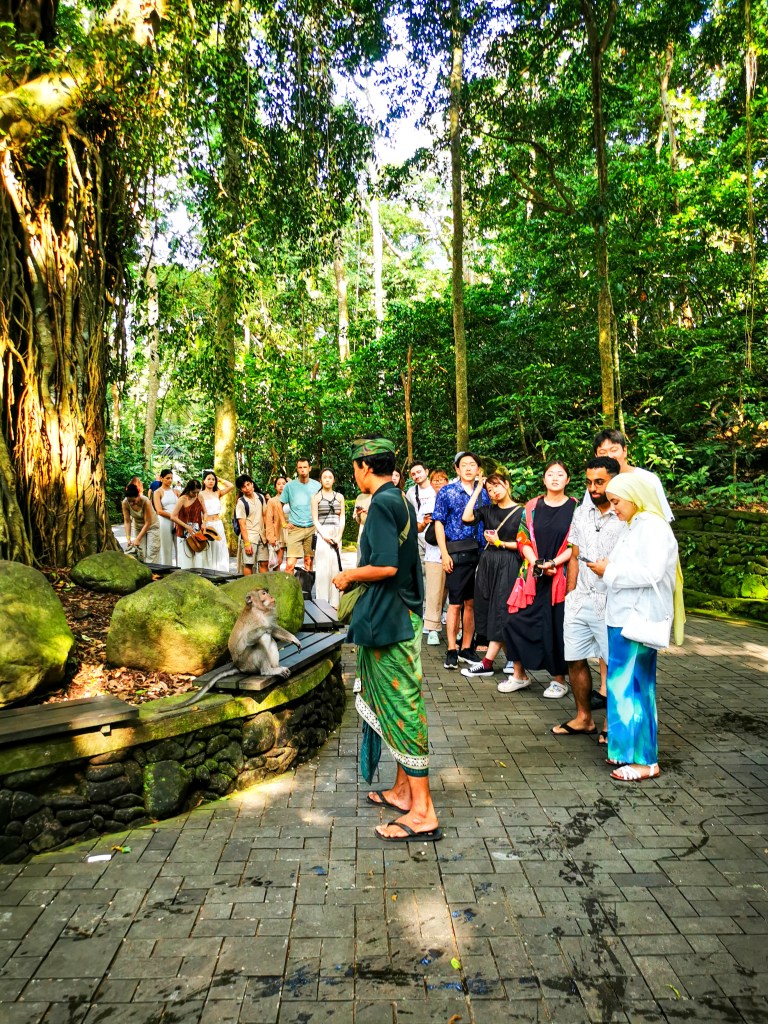
Photo Booth Opening Hours: A Lesson Learned
Before our trip, we struggled to find clear info on when exactly you can do the “Monkey Moment.” We assumed it was available all day long. Unfortunately, we were wrong, and our first attempt ended in disappointment when we found the booth closed.
We returned the next day, only to be told that the monkeys “weren’t in the mood” for photos and the booth wouldn’t be opening at all. Not wanting to waste any more time, we decided to get proactive and messaged the Monkey Forest directly via the WhatsApp number on their official website.


To our surprise, they replied! They let us know the booth would be open between 15:00 and 15:30 that day. Thanks to that tip, we finally managed to get our photo and had extra time to explore some of the deeper, quieter corners of the forest we’d missed before.
💡 Pro Tip: There are usually signs near the main ticket offices indicating whether the photo service is open or closed. However, it’s always a good idea to head to the information desk and ask specifically if the “Monkey Moment” is happening that day.
From what we gathered, the service is usually available shortly after the forest opens and again in the afternoon from around 15:00 to 15:30. However, this isn’t set in stone, so always check at the entrance!

Practical Tips for Visiting the Ubud Monkey Forest
The macaques in Ubud might be used to having humans around, but don’t forget—they’re still semi-wild animals. To make the most of your visit, it’s worth being well-prepared. Think of it less like a standard park and more like a kingdom where the monkeys truly rule the roost! 🐒
🕐 The Best Time to Visit
Early birds catch the worm (or in this case, avoid the monkey chaos). We recommend arriving right at opening time. There are fewer crowds, and the monkeys tend to be calmer and less “interested” in tourists (read: they’re less likely to try and rob you!). As the day goes on, it gets much busier, and the atmosphere can become quite intense.
🎒 Keep a Close Eye on Your Gear
This is the golden rule of the Monkey Forest:
- Hide your jewellery: Small, shiny objects will immediately catch a monkey’s eye.
- Stow away valuables: Keep your phone and wallet buried deep inside your backpack.
- Grip your phone tight: If you’re taking photos, make sure you have a firm hold on your device.
- No hats or sunglasses: Avoid wearing these on your head — they act like magnets for curious macaques! 🧲
- Zip it up: Keep your bags securely zipped, though be warned: a simple zip is only a minor challenge for these clever little thieves! 🫣
- No plastic bags: These are strictly banned. Even at the edge of the forest, outside the sanctuary walls, monkeys have been known to snatch shopping bags right out of people’s hands.
The monkeys here are lightning-fast and incredibly smart—they will take anything they find interesting.
🍌 Please, Don’t Feed the Monkeys
While interacting with the macaques might seem like fun, it’s best to steer clear of feeding them. It draws too much attention and can lead to aggressive behaviour. Additionally, bringing outside food into the sanctuary is prohibited—and believe us, their sensitive noses will find it! The staff feed the animals nine times a day, so they certainly aren’t going hungry.

👀 Keep Your Cool
Avoid direct eye contact, don’t show your teeth (no big grins!), and avoid sudden movements. If you’re travelling with children, keep them close at all times. If a monkey feels threatened, it may attack. But don’t worry—as long as you follow basic “monkey etiquette,” your visit should be perfectly safe.
👟 Comfortable Shoes are a Must-Have
The forest paths can be uneven and, in many places, very slippery. Sturdy, comfortable shoes are essential, especially if you plan on exploring for a few hours or if you’re visiting during the wet season.
💧 Stay Hydrated
It’s a tropical jungle, which means it’s hot and incredibly humid. Keeping water in your bag is a necessity, but remember to keep the bottle hidden! As for what to wear, light, breathable fabrics are your best friend.
🦟 Don’t Forget the Bug Spray
The forest and humidity make for a mosquito paradise. A high-strength repellent (ideally with 50% DEET) is a travel essential here.
📸 Capturing the Moment
The Monkey Forest is a photographer’s dream: the combination of ancient temples, lush jungle, and playful macaques is hard to beat. Just remember to keep a tight grip on your camera or phone.
Crucially, make sure your flash is turned off—the sudden bright light can spook the monkeys or even trigger an aggressive response.
To get the best shots of the macaques, a zoom lens is your best friend, as it allows you to capture those incredible details without getting uncomfortably close.

What to See Near the Ubud Monkey Forest
Since the Monkey Forest is located right in the heart of Ubud, it’s easy to combine your visit with several other nearby gems. Most are within walking distance or just a short scooter ride away.
🏯 Ubud Palace (20–25 minute walk)
The former royal residence, located in the very centre of Ubud. A visit here won’t take long, but it’s well worth it for the stunning Balinese architecture and intricate stone carvings. Plus, entry is free! In the evenings, the palace comes alive with traditional Balinese dance performances.
🛍️ Ubud Art Market (20–25 minute walk)
A vibrant hub filled with handicrafts, souvenirs, and local textiles. It’s the perfect place to pick up some Bali keepsakes, but be prepared to haggle! We recommend arriving early in the morning before the midday crowds descend.
🗺 Jalan Hanoman & Jalan Monkey Forest (Right next to the forest)
These are Ubud’s two main arteries, lined with endless restaurants, cafes, boutiques, and massage spas. This is where the town’s tourist life really happens. It’s the perfect area for a casual stroll or a bit of “aimless” wandering. Don’t be surprised if you spot macaques outside the forest walls here, often performing acrobatics on the overhead power lines!
🪷 Pura Taman Kemuda Saraswati – Ubud Water Palace (approx. 25 minute walk)
One of the most Instagrammable temples in Ubud, famous for its breathtaking lotus pond. Despite being just off the main road, it has a wonderfully peaceful atmosphere. It’s a great spot for a quick photo break. Right next door is the charming Café Lotus, where you can enjoy a coffee with a front-row view of the temple.
🌿 Campuhan Ridge Walk (approx. 35 minute walk)
A scenic nature trail that winds along a lush green ridge. It’s best enjoyed at sunrise or sunset to avoid the heat and the crowds. You’ll find some lovely, quiet cafes tucked away along the path.
🐘 Goa Gajah – Elephant Cave (approx. 20 minute drive)
A historic site featuring a cave entrance carved into the shape of a demonic face (spoiler alert: there are no actual elephants here!). It has a fascinating history and a much more ancient, mysterious vibe than the town centre.
🌾 Tegalalang Rice Terraces (approx. 30 minute drive)
These are the iconic, emerald-green terraces you’ve likely seen all over social media. The views are truly spectacular, though it is a very popular spot. Head there early in the morning to beat both the heat and the tour buses.
🐒 Sangeh Monkey Forest (approx. 40 minute drive)
If you’re looking for a quieter, more “off-the-beaten-track” experience, Sangeh is a fantastic alternative to the Ubud Monkey Forest. Surrounded by towering nutmeg trees, it feels much wilder and more authentic. The monkeys here are usually a bit less “pushy” than their Ubud cousins, making it a great choice if you prefer to avoid the crowds.


Is the Ubud Monkey Forest Worth Visiting?
If you’re wondering whether the Ubud Monkey Forest deserves a spot on your Bali itinerary, the short answer is: yes, but with a few caveats.
On one hand, it’s easily one of Bali’s most iconic attractions. There’s something truly magical about wandering through ancient temples swallowed by the jungle, surrounded by hundreds of free-roaming macaques. The unique blend of raw nature, Balinese spirituality, and local culture is genuinely impressive and hard to find anywhere else.
On the other hand, it’s worth remembering that this is not your average stroll through the park. These monkeys are wild, they can be quite pushy, and they require you to be on your guard. If you’re not particularly comfortable with close animal encounters or you prefer to avoid crowds, this might not be your cup of tea.

That said, we do think Ubud Monkey Forest is absolutely worth visiting — as long as you go in with the right mindset. It’s less of a “relax and enjoy the view” kind of place and more of a mini-adventure with a dash of adrenaline! 😄 However, as long as you follow the rules and keep our tips in mind, you’re in for a safe and memorable experience.
If, however, you’d prefer something a bit more tranquil, the Sangeh Monkey Forest is a fantastic alternative. It’s much less touristy, feels wilder, and is generally a lot more laid-back.
What about you — would you dare to go for a walk among hundreds of macaques? 🐒 Let us know in the comments!

Planning a trip to Bali? Check out our other posts:
Leave a Reply